

Volume 9, Issue 2 (4-2024)
CJHR 2024, 9(2): 85-94 |
Back to browse issues page



Download citation:
BibTeX | RIS | EndNote | Medlars | ProCite | Reference Manager | RefWorks
Send citation to:


BibTeX | RIS | EndNote | Medlars | ProCite | Reference Manager | RefWorks
Send citation to:
Moradi Janati A, Salehi S, Shaygan Majd F. The Mediating Role of Emotional Regulation in the Relationship between Attachment Styles and Psychological Well-being. CJHR 2024; 9 (2) :85-94
URL: http://cjhr.gums.ac.ir/article-1-344-en.html
URL: http://cjhr.gums.ac.ir/article-1-344-en.html


1- Department of Counseling, Faculty of Psychology and Educational Sciences, South Tehran Branch, Islamic Azad University, Tehran, Iran.
2- Department of Psychology and Counseling, Faculty of Psychology and Educational Sciences, South Tehran Branch, Islamic Azad University, Tehran, Iran ,2dr.salehi@gmail.com
3- Department of Clinical Psychology, Faculty of Psychology and Educational Sciences, South Tehran Branch, Islamic Azad University, Tehran, Iran.
2- Department of Psychology and Counseling, Faculty of Psychology and Educational Sciences, South Tehran Branch, Islamic Azad University, Tehran, Iran ,
3- Department of Clinical Psychology, Faculty of Psychology and Educational Sciences, South Tehran Branch, Islamic Azad University, Tehran, Iran.
Full-Text [PDF 638 kb]
(1354 Downloads)
| Abstract (HTML) (1675 Views)
Full-Text: (1596 Views)
Introduction
All people who get married, before starting their marriage, hope to have a stable and durable life together. They want to choose a worthy and appropriate spouse and live with her until the end of their lives, and they also want a healthy and happy family with a worthy and successful child or children, but these conditions are sometimes affected by factors that can reduce the satisfaction of couples over time resulting in conflicts with couples’ relationships [1]. It seems that the first psychological characteristics of couples that is affected is psychological well-being [2]. Psychological well-being refers to the level of interpersonal and positive functioning and reflects the dimensions of the impact of judgment about life satisfaction [3].
Well-being is a multi-dimensional component that includes positive emotions (hedonic well-being) and positive thoughts (virtuous well-being). Well-being is stable in the early period of life and then increases with age. Personality is also an essential factor for well-being, and among other influential factors in this field, living conditions and the quality of social relationships can be mentioned [4]. Psychological well-being is formed and developed based on the model presented by Ryff (2002), through the integration of different theories of individual growth and adaptive functioning. Based on this, well-being is a positive result that is meaningful for people and different parts of the society, because it shows that people are aware of the process and quality of their lives [5]. The absence of psychological well-being in people’s lives can cause negative life experiences such as depression, anxiety, anger, fear, and its active presence causes the experience of positive emotions, meaning, healthy relationships, mastery of the environment, interaction, and self-acceptance [6]. In this situation, examining factors related to well-being can be important. The results of researches have shown that one of the effective factors in psychological well-being is attachment style [3]. The type of attachment style plays a role in the psychological well-being and marital relationships of people [7].
Attachment theory was proposed by Bowlby for the first time in 1969 [8]. The main foundation of this theory is that the type or style of attachment of a newborn to his caregivers is a platform for his health or mental problems in his future life [9]. According to Bowlby [8], our primary attachment styles are formed during childhood and through the child-caregiver relationship [10]. Attachment theory has extended its working horizons even to adults and married couples [9]. Attachment, which is in the relationship between parent and child, is transferred to the adult romantic relationship and can affect behavior, cognition and emotions at any time of life [10]. Bowlby believes that the attachment in the parent-child relationship is transferred to the adult romantic relationship and can affect behavior, cognition, and emotions at any time of life, from infancy to adulthood [11]. Attachment as a special emotional relationship requires an exchange of comfort. Therefore, the connection and stable psychological connection between two people forms attachment.
On the other hand, the desire to create strong bonds with special people in one’s life is a basic factor in human nature [12]. According to Ainsworth’s theories, three common styles of attachment have been considered, which are: Secure attachment, which means creating a feeling of safety, visibility and comfort in people [13]. The high self-esteem of these people makes them approach others with a regular mentality and communicate with them [14]. Avoidance attachment is a type of attachment that is rooted in childhood and causes a person to have unattainable feelings and is oblivious to the people around him, and also because of his low self-esteem and feeling of insecurity, he always acts independently and asks for someone’s help [15]. And ambivalent attachment is a type of attachment that is formed based on doubt and mistrust and causes disappointing behavior in a person, and people with this type of attachment never feel satisfied. Because they do not trust others and communicate with them only to meet their needs and desires [16]. The attachment of couples usually works independently of the level of satisfaction experienced by them, because everyday problems, psychological disturbances in family relationships, which result in the occurrence of negative emotions, cause a decrease in attachment [17]. Hazan and Shaver have also confirmed Ainsworth three-story plan [18]. The classic adult attachment research was done by Hazan and Shaver [18]. They found that adults with secure attachment experience more trust and closeness in their romantic relationships than avoidant or anxious adults.
Various models and opinions regarding psychological well-being have been proposed by psychologists and experts in the field of mental health [19]. Research results showed that there is a significant relationship between emotional regulation and psychological well-being [20, 21]. Emotional regulation refers to the way people think and manage their behavior and thoughts after a negative and traumatic experience. This feature plays an important role in the process of normal and abnormal events, and is one of the appropriate ways to deal with negative stimuli [22]. In this regard, the theory presented by Thompson shows that emotional regulation includes external and internal processes responsible for monitoring, evaluating and modifying emotional reactions, especially its intense and fleeting characteristics in order to achieve individual goals [23]. In childhood and adulthood, all emotions do not always need to be controlled and regulated, but when their regulation can be adapted, there are many strategies to use these emotions, which is one of the common strategies, and mostly compatible is cognitive evaluation, that the purpose of which is to change the way a person thinks about the situation in order to change emotions [24]. Emotional regulation, which plays an important role in people’s anxiety and depression, can identify, evaluate and influence the nature, extent and manner of emotions. In general, it plays an important role in adapting to life changes and stressful events and allows people to use appropriate resistance strategies in facing situations that may be dangerous [25].
Emotional regulation can be considered as a factor that is influenced by attachment styles [26] and affects the psychological well-being of couples [27]. In the conducted researches, the relationship between emotional regulation and psychological well-being [21], the relationship between attachment styles and emotional regulation [16-28], and on the other hand the relationship between attachment styles, communication with the partner and well-being in couples [29] has been reported. However, no study was found to determine the relationship between attachment styles and psychological well-being through the mediating role of emotional regulation.
The importance of the present research can be examined from different aspects. One of these aspects is related to couples. Since the family is the most important social institution in human societies and couples play an important role in the development of children’s personality and upbringing and helping them adapt to the society in the later stages of life, paying attention to their psychological well-being is very important [30]. According to the vital role that couples have in society and their psychological well-being, it will affect the general health of the society, and on the other hand, it will also play a role in raising children this research is necessary. Also, if couples who have problems in terms of psychological well-being and their lives are affected by this problem, are left alone, there may be irreparable consequences such as the incidence of emotional divorce, marital coldness, marital dissatisfaction, behavioral disorders and addiction in children resulted, and on the other hand, the results of this study can be used by psychologists and counselors. So, the study in this field is very necessary to fill this research gap. Therefore, the question of the present research is whether emotional regulation has a mediating role in the relationship between attachment styles and psychological well-being?
Materials and Methods
Study type and study population
The statistical population of this research was all the couples who referred to Taranome Zendegi Counseling Center and Atiyeh Counseling Center located in the 2nd district of Qazvin City in the first quarter of 1401. The method of sampling in this research was convenience sampling. According to the rule of thumb, 2.5 to 5 observation per item with a minimum number of 200 sample can be considered for structural equation modeling (SEM) [31]. Based on 69 items of the questionnaires and considering 30% dropout, we estimated 250 people (125 male and 125 female) for this study.
The required permission was obtained from the Islamic Azad University, South Tehran Branch, Taranome Zendegi Counseling Center, and Atiyeh Counseling Center located in District 2 of Qazvin City.
Measures
Ryff psychological well-being scale-short form (RSPWB-SF)
This scale was designed by Ryff in 1989 and revised in 2002 at the University of Wisconsin Medical Sciences Center. The short form of this scale is derived from the original form with 120 items. This version has 18 items and its purpose is to evaluate and examine psychological well-being, for this purpose, the present scale measures 6 factors, which are: Independence, mastery of the environment, personal growth, the factor of positive communication with others, purposefulness in life, and self-acceptance. This instrument is answered on a 5-point continuum, according to which the option (strongly disagree) receives a score of 1 and the option (strongly agree) receives a score of 5. The minimum score obtained from this scale is 18 and the maximum score is 90. A higher score indicates better psychological well-being. In order to check the validity of the instrument and measure its relationship with the tests that measure personality traits and were also considered psychological well-being indicators, from Bradburn’s emotional balance scale [32], Tobin and Neugarten’s life satisfaction [33] and dignity Rosenberg himself [34] was used. The correlation results of the Ryff test with each of the above scales were 0.47, 0.58 and 0.46 respectively. Therefore, the above tool was considered valid in terms of structure [31]. Cronbach’s α obtained in the study for self-acceptance (0.93), effective communication with others (0.91), autonomy (0.86), mastery of the environment (0.90), purposefulness in life (0.90) and personal growth (0.87) have been reported by Ryff [32].During the research conducted by Kreicie and Morgan (1970) with a student sample, internal consistency was measured using Cronbach’s α. The results were 0.69 for mastering the environment, 0.74 for personal growth, 0.65 for positive communication with others, 0.73 for purpose in life, 0.65 for self-acceptance, 0.60 for autonomy, and 0.90 for the overall score. Also in a research which conducted in Iran, they showed that the six-factor model of this scale (self-acceptance, environmental mastery, positive relationship with others, having a goal in life, personal growth and independence) has a good fit. The validity of this scale using Cronbach’s α in 6 factors of self-acceptance, environmental mastery, positive relationship with others, having a purpose in life, personal growth and independence is equal to 0.51, 0.76, 0.75, 0.52 respectively. 0.73, 0.72 and 0.71 for the whole scale were obtained [35]. In the present study, Cronbach’s α reliability coefficient for this scale was 0.77.
Hazan and Shaver attachment style questionnaire: This attachment scale, which is standardized for Tehran University students, has 15 items that measure the three subscales of secure, avoidant and ambivalent attachment styles [18]. This questionnaire has 15 items and measures three attachment styles: Secure, avoidant, and ambivalent in a 5-point Likert scale (very low-1, low-2, medium-3, high-4, very high-5). In order to determine the attachment style of each person, the numerical value of the expressions related to each of the three attachment styles are added together and divided by 5. The subscale with a higher mean is considered as the participant’s attachment style. Hazan and Shaver [18] obtained total retest reliability of 0.81 and 0.78 through Cronbach’s α [36]. In an Iranian research, the Cronbach’s α coefficient of safe, avoidant, and ambivalent subscale items for a student sample (1480 people, including 860 girls and 620 boys) for all subjects were 0.86, 0.84, and 0.85, respectively (for female students 0.86, 0.83, 0.84 and for male students 0.84, 0.85 and 0.86) was calculated, which is a sign of good internal consistency of the adult attachment scale. Kendall’s coefficients of agreement (validity) were calculated for secure, avoidant and ambivalent attachment styles as 0.80, 0.61 and 0.75 respectively [37]. In the present study, Cronbach’s α reliability coefficient for this questionnaire was obtained as 0.80, 0.54 and 0.82 respectively for safe, avoidant and ambivalent (anxious) subscales.
Garnefski emotional regulation questionnaire
This questionnaire is a multi-dimensional and self-report tool with 5 options (2001) [38] which has 36 items. Emotional regulation scale 2 strategies of positive emotional regulation and negative emotional regulation through the dimensions of self-blame, acceptance, rumination, positive refocusing, refocusing on planning, positive reappraisal, perspective taking, catastrophizing and blame others evaluate. Its response range was of Likert scale where the score for each option is equal to 5, 4, 3, 2 and 1 respectively for always, often, regularly, sometimes and never. The score of each strategy is obtained through the sum of the scores given to each of the statements that make up that strategy and can be in the range of 4 to 20, and the sum of the total scores is in the range of 32 to 180. Garnefski [38] reported the Cronbach’s α coefficient for the subscales of this questionnaire between 0.71 and 0.81 and its validity through correlation between subscales (correlation coefficient between 0.75 and 0.90 between subscales) has done. The Persian form of this scale has been validated in a research with Cronbach’s α coefficient of 0.89, and the validity of the mentioned questionnaire was determined through principal component analysis using Varimax rotation, correlation between subscales (with a correlation range of 0.32 to 0.67). It has been reported [39]. In the present study, Cronbach’s α reliability coefficient for this questionnaire was 0.84.
Statistical analysis
Data were described using frequency, percentage, Mean±SD according to the type of the variables. To explore the relation between variables, SEM was used with the maximum likelihood method. Two latent variables of emotion regulation and attachment styles and their markers were examined in the measurement model of the present study. The goodness of fit of the measurement model was assessed using chi-square index (χ2), chi-square ratio index to degree of freedom (χ2/df), Tucker-Lewis index (TLI), comparative fit index (CFI), normed fit index (NFI) and root mean squared error of approximation (RMSEA) has been investigated. SPSS software, version 26 and AMOS software, version 24 were used for data analysis.
Results
Regrading to the age of the respondents, 61 participants (24.40%) were in the age group of 25 to 30 years, 80 people (32%) in the age group of 31 to 35 years, 53 people (21.2%) in the age group of 36 to 40 years, 37 people (14.8%) in the age group of 41 to 45 years and 19 people (7.6%) were in the age group of 46 years and above. Regarding to the level of education of the respondents 94 people (37.60%) had diploma and high school degree, 17 people (6.80%) had associate degree,83 people (equivalent to 33.20%) in the undergraduate group and 56 people (equivalent to 22.40%) in the master’s and doctorate group, and based on gender, there were 125 respondents (equivalent to 50%) in the female group and 125 respondents (equivalent to 50%) were in the male group.
Descriptive statistics of research variables are shown in Table 1.
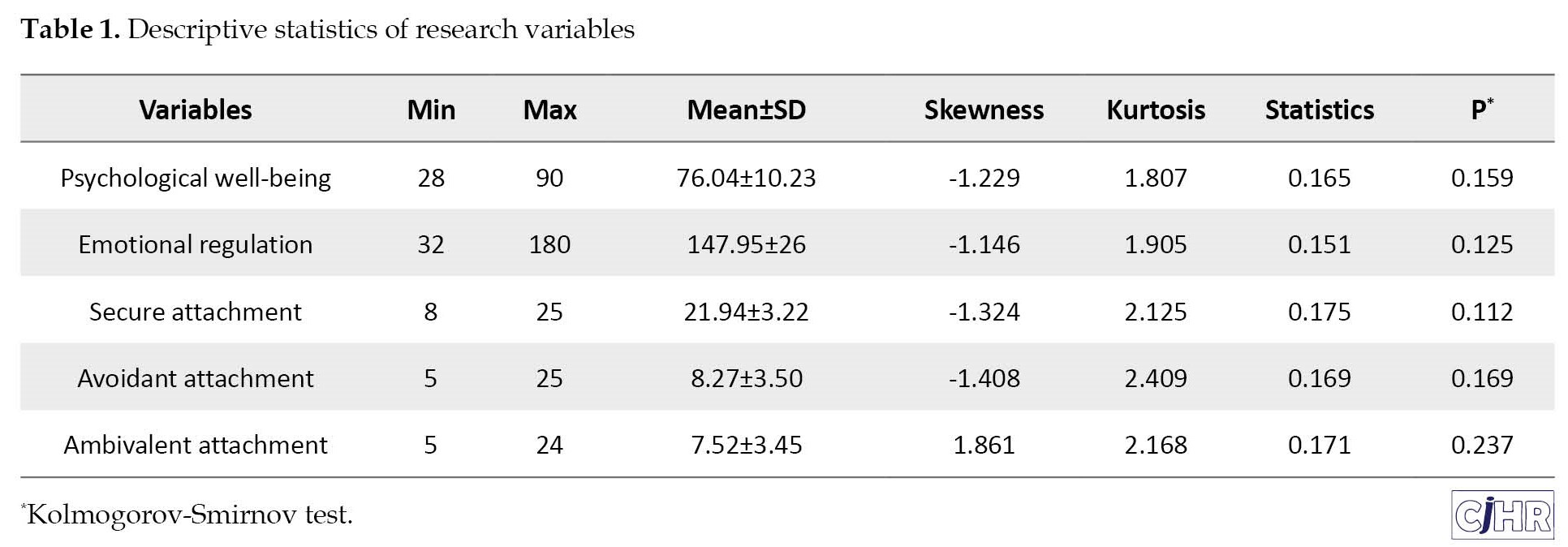
According to the Kolmogorov-Smirnov test and kurtosis and skewness indices, the assumption of normality was met. Fitting the measurement model using chi-square index (χ2), chi-square ratio index to degree of freedom (χ2/df), TLI, CFI, NFI and RMSEA has been investigated. CFI, NFI, TLI fit indices >0.90; RMSEA less than 0.08 and (χ2/df) less than 5 indicate a good fit of the measurement model. The collinearity between variables was assessed using tolerance >0.1 and variance inflation factor <10.
Table 2 shows the results of the correlation between the main variables with the Pearson coefficient test.
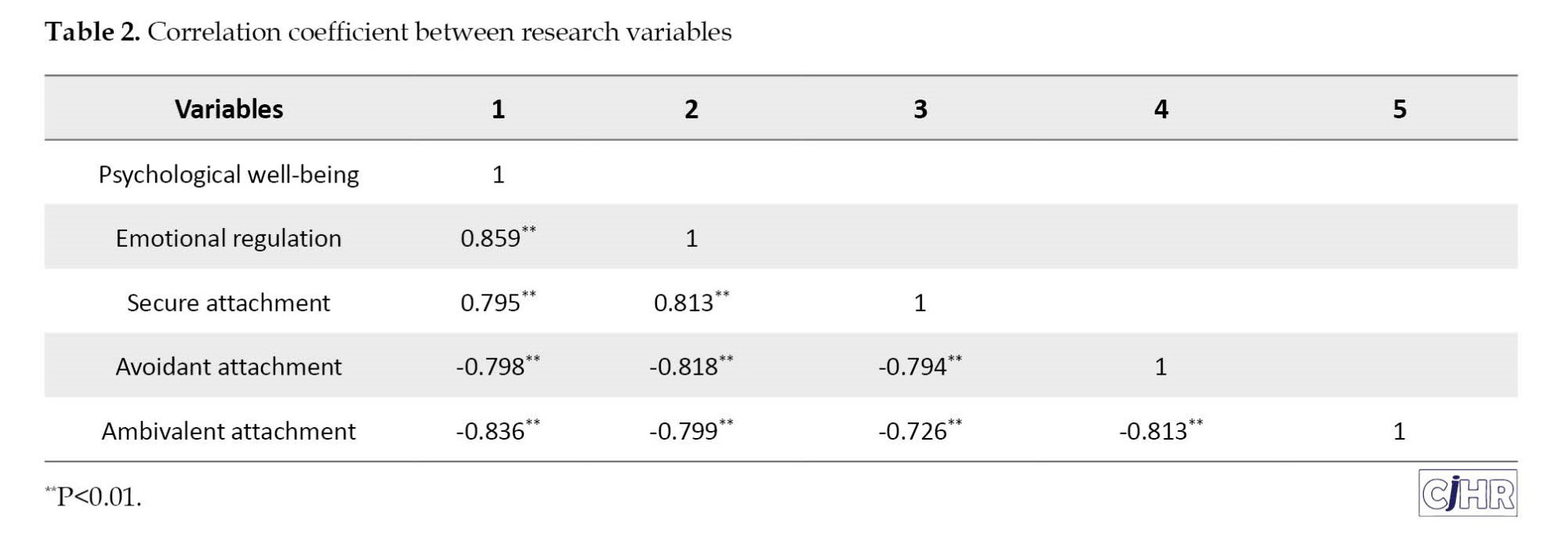
As it is evident, the correlation coefficient between the psychological well-being variable and the emotional regulation variable is 0.859 at the significance level of 0.01, which indicate a positive and very strong association. There is also a direct and strong association between psychological well-being and secure attachment style (r=0.795, P<0.01). in contrast, psychological well-being showed an inverse and strong association with avoidant and ambivalent attachment style.
Figure 1 shows the results of the final model of the effect of attachment styles (secure, avoidant and ambivalent) on psychological well-being along with the mediating role of emotional regulation.
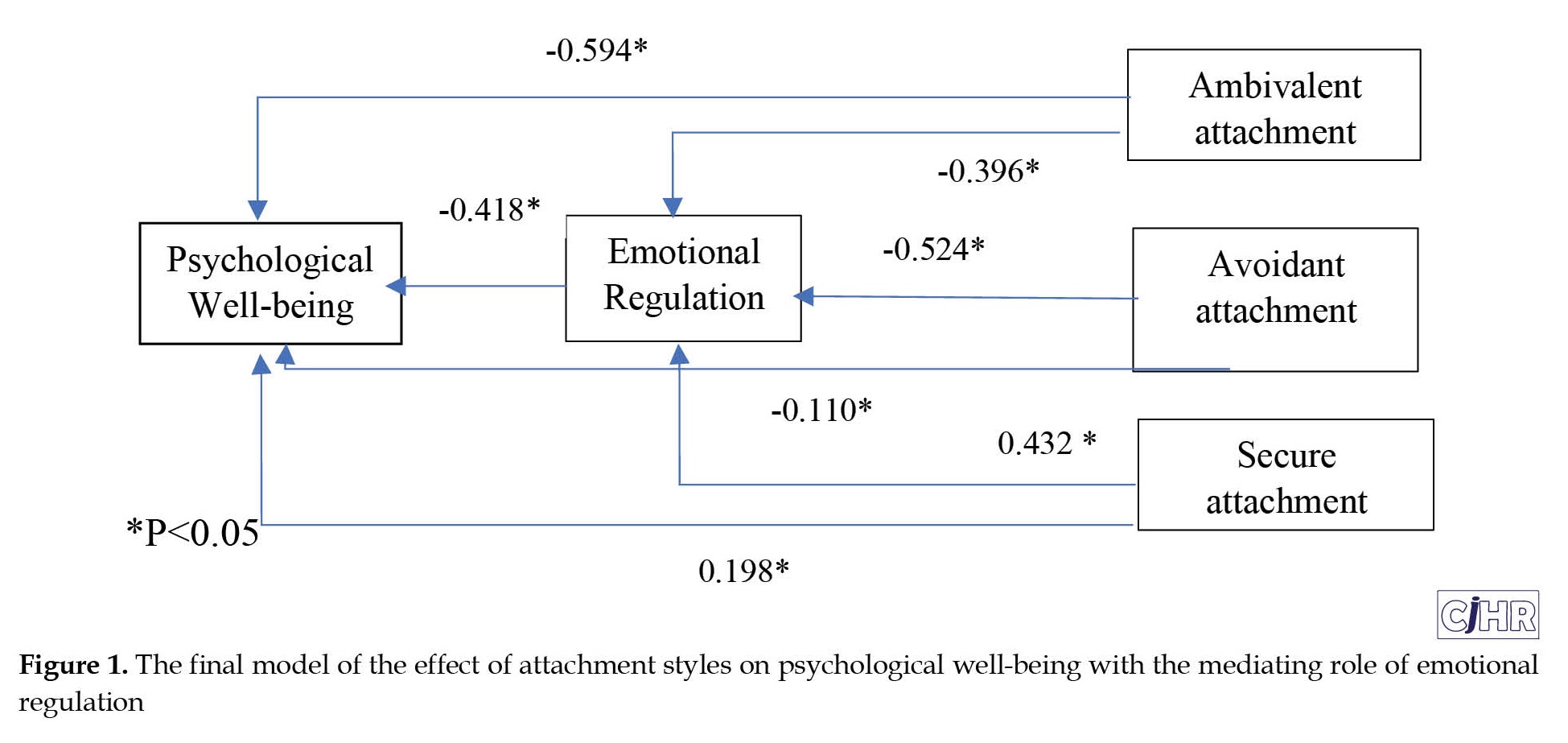 The results of the fit indices of the SEM model according to the chi-square ratio=4.038, which was <5, NFI=0.982, CFI=0.916, and PNFI=0.969 which all of them were >0.9, RMSEA=0.082, approved the model goodness of fit.
Table 3 shows the results of direct, indirect and, total effects of variables in the model.
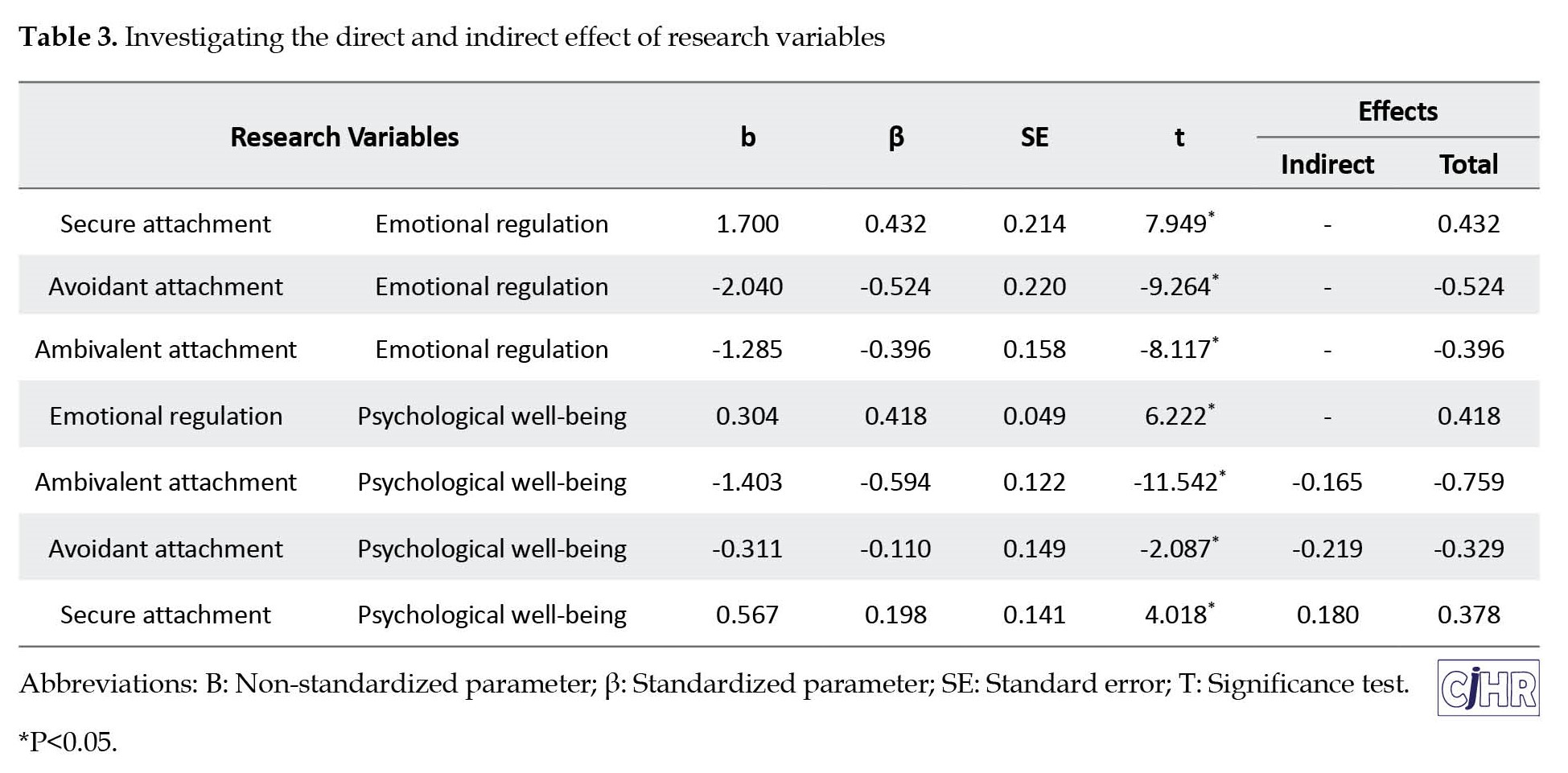
As it is evident, the three secure, avoidant and anxious attachment styles with the standard coefficient of 0.432, -0.524 and -0.396 respectively have a significant effect on the emotional regulation variable. In the comparison between the total effects of research variables on psychological well-being, it shows that the highest total effect is related to the variable of anxious attachment with a coefficient of -0.759, followed by the variable of emotional regulation with a coefficient of 0.418 and secure attachment with a coefficient of 0.378. The three attachment styles of avoidant, anxious, and secure were able to explain the changes in the variable of emotional regulation by 61.8%. The coefficient of determination of emotional regulation variable and three attachment styles was 0.798.
Discussion
This research was conducted with the main purpose of determining the mediating role of emotional regulation in the relationship between attachment styles and psychological well-being. The results showed that there is a significant positive relationship between secure attachment style and psychological well-being and a significant negative relationship between ambivalent (anxious) attachment style and psychological well-being. There is a significant negative relationship between avoidant attachment style and psychological well-being. The results of this part of the hypothesis were consistent with the results of the researches of Costa and Betelheiro (2021) and Ramos et al. (2020) [7, 40]. In their research, Ramos et al. [7] investigated the attachment styles of communication with the partner and well-being in couples dealing with cancer. The results of the mediation model of partner interdependence showed that insecure attachment styles have a weak and negative relationship with people’s well-being.
In order to explain the relationship between attachment styles and psychological well-being, we can refer to Ryff’s theory [5]. According to Ryff’s point of view, well-being is introduced as a factor that motivates a person to try to prove his abilities. It can be said that people with a secure attachment style have high self-esteem, they are right-minded towards people, and they base their thoughts on reality in their communication. They think positively and realistically about themselves and their loved ones, as well as about their interpersonal relationships, and often feel satisfied with their relationships. Psychological well-being can be defined as having a positive attitude towards oneself, constructive interaction with the surrounding world, and having hope and purpose in life; Someone with psychological health h::as char::acteristics such as self-esteem, extensive social connections, a sense of self-efficacy and a sense of independence. Therefore, people with secure attachment mainly experience a high sense of well-being and have a positive evaluation of the incidents and events around them. People with an avoidant style often choose suspicious and problematic people to get confirmation of their mistrust pattern. Therefore, they usually unconsciously choose failure in their relationships, which is in conflict with psychological well-being that includes positive and satisfied feelings, so people with avoidant attachment style have low psychological well-being [7]. Among the signs of people with an ambivalent style are extreme jealousy (fear of losing a partner) and control, being skeptical, criticizing and arguing a lot about useless issues in relationships. Dependent behavior is seen in such people more than other attachment styles and considering that psychological well-being includes life satisfaction, emotional balance and general attitude towards optimism with a positive orientation towards life, so people with ambivalent style cannot have high psychological well-being and the relationship between these two is inverse.
The results of the research showed that there is a significant positive relationship between emotional regulation and psychological well-being. The results of this hypothesis were consistent with the results of the research of ST-Louis et al. [21] Puente-Martínez et al. [27].
In order to explain the relationship between emotional regulation and psychological well-being based on the emotional regulation theory of gross [23], emotional regulation can be a set of two factors of cognitive re-evaluation (having a positive view, towards a seemingly unfavorable situation) along with emotion inhibition (prevention of unpleasant or useless emotions). In this way, emotional regulation is considered an important prerequisite for many psychosocial activities of a person such as cognitive processing, exploratory behaviors, social ability and problem solving. In fact, emotion regulation is not the suppression of emotions, but includes the processes of monitoring and changing a person’s emotional experiences, which have an impact on a person’s life, and considering that psychological well-being is a positive feeling and a general feeling of satisfaction with life that It includes oneself and others in different areas of family, job and the like, so it can be said that emotional regulation has an effect on psychological well-being [24]. Therefore, people with a high sense of well-being mainly experience more positive emotions and have a positive evaluation of the incidents and events around them.
Also, the results showed that there is a significant positive relationship between secure attachment style and emotional regulation, and a significant negative relationship between ambivalent (anxious) attachment style and emotional regulation. The results of this hypothesis were consistent with the results of Tholia and Suri [28] and Ramos et al [29].
In order to explain the relationship between attachment styles and emotional regulation, we can refer to Menin’s theory (2006). According to this theory, anxious people experience their emotions more intensely than most people, or in other words, they have emotional hyper arousal. Compared to other people, they have a weaker understanding of their emotions and cannot control it. On the contrary, calm and psychologically secure people have better management of their emotions. Based on this, it can be said that secure attachment is like a psychological safe source and one of the main dimensions of “mental health” for every person, which can be the basis of a person’s movement towards independence and the development of all personality dimensions. This group of people have high emotional intelligence and can correctly identify and manage their emotions [23]. Emotional regulation refers to the way people think and manage after a negative and traumatic experience, so people with a secure attachment style have more emotional regulation because of their high emotional intelligence and identify emotions. People with an avoidant style feel uncomfortable when their getting close to others and cannot fully trust others. Although such people appear to be self-sufficient and independent and avoid warm and sincere communication with others, this behavior is actually a cover for their insecure and low self-esteem. People with an ambivalent (anxious) style express strong dissatisfaction with the absence of the person in front of them, but when they reach him, they still express dissatisfaction. Extreme jealousy (fear of losing the partner) and controlling, being skeptical, criticizing, and arguing over useless issues in relationships are the signs of such people, and these wrong behaviors lead to confusion and lack of control in emotions. Emotions are reduced and the individual’s tendency to seek emotional regulation is reduced, and an ambivalent person has less emotional regulation [24].
The results also showed that emotional regulation plays a mediating role in the relationship between attachment styles and psychological well-being. The findings indicated that the indirect path of attachment styles to psychological well-being through emotional regulation is meaningful. In addition, the indirect path of secure attachment style to psychological well-being through emotional regulation is meaningful and positive. The indirect path of avoidant attachment style to psychological well-being has meaningful and negative relation through emotional regulation.
In order to investigate this hypothesis, we studied researches conducted on the relationship between attachment styles and emotional regulation (Tholia and Suri [28]), the relationship between emotional regulation and psychological well-being ST-Louis et al. [21], and the relationship between attachment styles and psychological well-being Ramos et al. [29].
In the explanation of this hypothesis, based on Gross’s view, cognitive emotion regulation strategies exert their effects during the evaluation of potential situations or during the adjustment of response tendencies. People who are emotionally disciplined know what emotions they have, when and where, and how to experience and express them. Based on this, emotion regulation can be influenced by attachment styles and affect psychological well-being [21]. Self-regulation is an important internal force that enables people to strengthen their positive psychological components such as psychological well-being. As emotional regulation plays an essential role in normal development and its deficiency is an important factor in the occurrence of mental disorders, couples who can properly control their emotions against daily events are more likely to have favorable psychological well-being. [7] It is assumed that according to the findings, couples who are not able to effectively manage and control their emotional reactions in front of their spouse experience longer and more severe periods of psychological discomfort, which may be symptoms of attachment style such as avoidant or ambivalent styles. When people have a high avoidant attachment style, due to being far from others and not trusting others, they are unable to manage exciting and stimulating information in relation to others, and their emotional regulation decreases [20]. Due to the fact that stressful events are very emotional in nature, people who have a secure attachment style can show better emotional regulation. Attachment styles are mentioned as one of the effective factors for emotional regulation. Couples who use strategies such as reappraisal to regulate emotions have better psychological well-being and better performance in facing stressful events [21].
Among the limitations of this research, it can be pointed out that this research was only conducted on couples who referred to Taranome Zendegi Counseling Center and Atiyeh Counseling Center located in District 2 of Qazvin City, and the generalization of the results to other centers and other cities should be done with caution. Therefore, it is suggested that this research be done at the country level and with other sampling methods. Researchers and those interested in this field are suggested to pay attention to the role of moderating factors such as gender, marital status, etc. in their research in investigating relationships.
Conclusion
In general, based on the explanation of the relationships between attachment styles and emotional regulation, the relationship between emotional regulation and psychological well-being, and the relationship between attachment styles and psychological well-being, it was shown that emotional regulation in the relationship between attachment styles and psychological well-being has a mediating role. It is suggested that counseling and psychotherapy centers hold awareness courses to improve emotional regulation for couples, and by identifying the attachment styles of couples and raising awareness in the field of emotional regulation, the psychological well-being of couples can be strengthened.
Ethical Considerations
Compliance with ethical guidelines
This study was approved by the Ethics Committee of Islamic Azad University, Central Branch (Code: IR.IAU.CTB.REC.1401.061). The selected participants was given information about the purpose of the research, the content of the questionnaire, as well as the principle of confidentiality and anonymity of the information and then informed consent was taken from them.
Funding
This research did not receive any grant from funding agencies in the public, commercial, or non-profit sectors.
Authors' contributions
Conceptualization, funding administration, investigation and data collection: Akram Moradi Janati; Data analysis: All authors; Writing the original draft: Farnaz Shaygan Majd; Methodology, review and editing: Somaieh Salehi and Akram Moradi Janati; Supervision: Somaieh Salehi.
Conflict of interest
The authors declared no conflict of interest.
Acknowledgements
The authors are grateful to all the honorable couples who participated in this research.
References
All people who get married, before starting their marriage, hope to have a stable and durable life together. They want to choose a worthy and appropriate spouse and live with her until the end of their lives, and they also want a healthy and happy family with a worthy and successful child or children, but these conditions are sometimes affected by factors that can reduce the satisfaction of couples over time resulting in conflicts with couples’ relationships [1]. It seems that the first psychological characteristics of couples that is affected is psychological well-being [2]. Psychological well-being refers to the level of interpersonal and positive functioning and reflects the dimensions of the impact of judgment about life satisfaction [3].
Well-being is a multi-dimensional component that includes positive emotions (hedonic well-being) and positive thoughts (virtuous well-being). Well-being is stable in the early period of life and then increases with age. Personality is also an essential factor for well-being, and among other influential factors in this field, living conditions and the quality of social relationships can be mentioned [4]. Psychological well-being is formed and developed based on the model presented by Ryff (2002), through the integration of different theories of individual growth and adaptive functioning. Based on this, well-being is a positive result that is meaningful for people and different parts of the society, because it shows that people are aware of the process and quality of their lives [5]. The absence of psychological well-being in people’s lives can cause negative life experiences such as depression, anxiety, anger, fear, and its active presence causes the experience of positive emotions, meaning, healthy relationships, mastery of the environment, interaction, and self-acceptance [6]. In this situation, examining factors related to well-being can be important. The results of researches have shown that one of the effective factors in psychological well-being is attachment style [3]. The type of attachment style plays a role in the psychological well-being and marital relationships of people [7].
Attachment theory was proposed by Bowlby for the first time in 1969 [8]. The main foundation of this theory is that the type or style of attachment of a newborn to his caregivers is a platform for his health or mental problems in his future life [9]. According to Bowlby [8], our primary attachment styles are formed during childhood and through the child-caregiver relationship [10]. Attachment theory has extended its working horizons even to adults and married couples [9]. Attachment, which is in the relationship between parent and child, is transferred to the adult romantic relationship and can affect behavior, cognition and emotions at any time of life [10]. Bowlby believes that the attachment in the parent-child relationship is transferred to the adult romantic relationship and can affect behavior, cognition, and emotions at any time of life, from infancy to adulthood [11]. Attachment as a special emotional relationship requires an exchange of comfort. Therefore, the connection and stable psychological connection between two people forms attachment.
On the other hand, the desire to create strong bonds with special people in one’s life is a basic factor in human nature [12]. According to Ainsworth’s theories, three common styles of attachment have been considered, which are: Secure attachment, which means creating a feeling of safety, visibility and comfort in people [13]. The high self-esteem of these people makes them approach others with a regular mentality and communicate with them [14]. Avoidance attachment is a type of attachment that is rooted in childhood and causes a person to have unattainable feelings and is oblivious to the people around him, and also because of his low self-esteem and feeling of insecurity, he always acts independently and asks for someone’s help [15]. And ambivalent attachment is a type of attachment that is formed based on doubt and mistrust and causes disappointing behavior in a person, and people with this type of attachment never feel satisfied. Because they do not trust others and communicate with them only to meet their needs and desires [16]. The attachment of couples usually works independently of the level of satisfaction experienced by them, because everyday problems, psychological disturbances in family relationships, which result in the occurrence of negative emotions, cause a decrease in attachment [17]. Hazan and Shaver have also confirmed Ainsworth three-story plan [18]. The classic adult attachment research was done by Hazan and Shaver [18]. They found that adults with secure attachment experience more trust and closeness in their romantic relationships than avoidant or anxious adults.
Various models and opinions regarding psychological well-being have been proposed by psychologists and experts in the field of mental health [19]. Research results showed that there is a significant relationship between emotional regulation and psychological well-being [20, 21]. Emotional regulation refers to the way people think and manage their behavior and thoughts after a negative and traumatic experience. This feature plays an important role in the process of normal and abnormal events, and is one of the appropriate ways to deal with negative stimuli [22]. In this regard, the theory presented by Thompson shows that emotional regulation includes external and internal processes responsible for monitoring, evaluating and modifying emotional reactions, especially its intense and fleeting characteristics in order to achieve individual goals [23]. In childhood and adulthood, all emotions do not always need to be controlled and regulated, but when their regulation can be adapted, there are many strategies to use these emotions, which is one of the common strategies, and mostly compatible is cognitive evaluation, that the purpose of which is to change the way a person thinks about the situation in order to change emotions [24]. Emotional regulation, which plays an important role in people’s anxiety and depression, can identify, evaluate and influence the nature, extent and manner of emotions. In general, it plays an important role in adapting to life changes and stressful events and allows people to use appropriate resistance strategies in facing situations that may be dangerous [25].
Emotional regulation can be considered as a factor that is influenced by attachment styles [26] and affects the psychological well-being of couples [27]. In the conducted researches, the relationship between emotional regulation and psychological well-being [21], the relationship between attachment styles and emotional regulation [16-28], and on the other hand the relationship between attachment styles, communication with the partner and well-being in couples [29] has been reported. However, no study was found to determine the relationship between attachment styles and psychological well-being through the mediating role of emotional regulation.
The importance of the present research can be examined from different aspects. One of these aspects is related to couples. Since the family is the most important social institution in human societies and couples play an important role in the development of children’s personality and upbringing and helping them adapt to the society in the later stages of life, paying attention to their psychological well-being is very important [30]. According to the vital role that couples have in society and their psychological well-being, it will affect the general health of the society, and on the other hand, it will also play a role in raising children this research is necessary. Also, if couples who have problems in terms of psychological well-being and their lives are affected by this problem, are left alone, there may be irreparable consequences such as the incidence of emotional divorce, marital coldness, marital dissatisfaction, behavioral disorders and addiction in children resulted, and on the other hand, the results of this study can be used by psychologists and counselors. So, the study in this field is very necessary to fill this research gap. Therefore, the question of the present research is whether emotional regulation has a mediating role in the relationship between attachment styles and psychological well-being?
Materials and Methods
Study type and study population
The statistical population of this research was all the couples who referred to Taranome Zendegi Counseling Center and Atiyeh Counseling Center located in the 2nd district of Qazvin City in the first quarter of 1401. The method of sampling in this research was convenience sampling. According to the rule of thumb, 2.5 to 5 observation per item with a minimum number of 200 sample can be considered for structural equation modeling (SEM) [31]. Based on 69 items of the questionnaires and considering 30% dropout, we estimated 250 people (125 male and 125 female) for this study.
The required permission was obtained from the Islamic Azad University, South Tehran Branch, Taranome Zendegi Counseling Center, and Atiyeh Counseling Center located in District 2 of Qazvin City.
Measures
Ryff psychological well-being scale-short form (RSPWB-SF)
This scale was designed by Ryff in 1989 and revised in 2002 at the University of Wisconsin Medical Sciences Center. The short form of this scale is derived from the original form with 120 items. This version has 18 items and its purpose is to evaluate and examine psychological well-being, for this purpose, the present scale measures 6 factors, which are: Independence, mastery of the environment, personal growth, the factor of positive communication with others, purposefulness in life, and self-acceptance. This instrument is answered on a 5-point continuum, according to which the option (strongly disagree) receives a score of 1 and the option (strongly agree) receives a score of 5. The minimum score obtained from this scale is 18 and the maximum score is 90. A higher score indicates better psychological well-being. In order to check the validity of the instrument and measure its relationship with the tests that measure personality traits and were also considered psychological well-being indicators, from Bradburn’s emotional balance scale [32], Tobin and Neugarten’s life satisfaction [33] and dignity Rosenberg himself [34] was used. The correlation results of the Ryff test with each of the above scales were 0.47, 0.58 and 0.46 respectively. Therefore, the above tool was considered valid in terms of structure [31]. Cronbach’s α obtained in the study for self-acceptance (0.93), effective communication with others (0.91), autonomy (0.86), mastery of the environment (0.90), purposefulness in life (0.90) and personal growth (0.87) have been reported by Ryff [32].During the research conducted by Kreicie and Morgan (1970) with a student sample, internal consistency was measured using Cronbach’s α. The results were 0.69 for mastering the environment, 0.74 for personal growth, 0.65 for positive communication with others, 0.73 for purpose in life, 0.65 for self-acceptance, 0.60 for autonomy, and 0.90 for the overall score. Also in a research which conducted in Iran, they showed that the six-factor model of this scale (self-acceptance, environmental mastery, positive relationship with others, having a goal in life, personal growth and independence) has a good fit. The validity of this scale using Cronbach’s α in 6 factors of self-acceptance, environmental mastery, positive relationship with others, having a purpose in life, personal growth and independence is equal to 0.51, 0.76, 0.75, 0.52 respectively. 0.73, 0.72 and 0.71 for the whole scale were obtained [35]. In the present study, Cronbach’s α reliability coefficient for this scale was 0.77.
Hazan and Shaver attachment style questionnaire: This attachment scale, which is standardized for Tehran University students, has 15 items that measure the three subscales of secure, avoidant and ambivalent attachment styles [18]. This questionnaire has 15 items and measures three attachment styles: Secure, avoidant, and ambivalent in a 5-point Likert scale (very low-1, low-2, medium-3, high-4, very high-5). In order to determine the attachment style of each person, the numerical value of the expressions related to each of the three attachment styles are added together and divided by 5. The subscale with a higher mean is considered as the participant’s attachment style. Hazan and Shaver [18] obtained total retest reliability of 0.81 and 0.78 through Cronbach’s α [36]. In an Iranian research, the Cronbach’s α coefficient of safe, avoidant, and ambivalent subscale items for a student sample (1480 people, including 860 girls and 620 boys) for all subjects were 0.86, 0.84, and 0.85, respectively (for female students 0.86, 0.83, 0.84 and for male students 0.84, 0.85 and 0.86) was calculated, which is a sign of good internal consistency of the adult attachment scale. Kendall’s coefficients of agreement (validity) were calculated for secure, avoidant and ambivalent attachment styles as 0.80, 0.61 and 0.75 respectively [37]. In the present study, Cronbach’s α reliability coefficient for this questionnaire was obtained as 0.80, 0.54 and 0.82 respectively for safe, avoidant and ambivalent (anxious) subscales.
Garnefski emotional regulation questionnaire
This questionnaire is a multi-dimensional and self-report tool with 5 options (2001) [38] which has 36 items. Emotional regulation scale 2 strategies of positive emotional regulation and negative emotional regulation through the dimensions of self-blame, acceptance, rumination, positive refocusing, refocusing on planning, positive reappraisal, perspective taking, catastrophizing and blame others evaluate. Its response range was of Likert scale where the score for each option is equal to 5, 4, 3, 2 and 1 respectively for always, often, regularly, sometimes and never. The score of each strategy is obtained through the sum of the scores given to each of the statements that make up that strategy and can be in the range of 4 to 20, and the sum of the total scores is in the range of 32 to 180. Garnefski [38] reported the Cronbach’s α coefficient for the subscales of this questionnaire between 0.71 and 0.81 and its validity through correlation between subscales (correlation coefficient between 0.75 and 0.90 between subscales) has done. The Persian form of this scale has been validated in a research with Cronbach’s α coefficient of 0.89, and the validity of the mentioned questionnaire was determined through principal component analysis using Varimax rotation, correlation between subscales (with a correlation range of 0.32 to 0.67). It has been reported [39]. In the present study, Cronbach’s α reliability coefficient for this questionnaire was 0.84.
Statistical analysis
Data were described using frequency, percentage, Mean±SD according to the type of the variables. To explore the relation between variables, SEM was used with the maximum likelihood method. Two latent variables of emotion regulation and attachment styles and their markers were examined in the measurement model of the present study. The goodness of fit of the measurement model was assessed using chi-square index (χ2), chi-square ratio index to degree of freedom (χ2/df), Tucker-Lewis index (TLI), comparative fit index (CFI), normed fit index (NFI) and root mean squared error of approximation (RMSEA) has been investigated. SPSS software, version 26 and AMOS software, version 24 were used for data analysis.
Results
Regrading to the age of the respondents, 61 participants (24.40%) were in the age group of 25 to 30 years, 80 people (32%) in the age group of 31 to 35 years, 53 people (21.2%) in the age group of 36 to 40 years, 37 people (14.8%) in the age group of 41 to 45 years and 19 people (7.6%) were in the age group of 46 years and above. Regarding to the level of education of the respondents 94 people (37.60%) had diploma and high school degree, 17 people (6.80%) had associate degree,83 people (equivalent to 33.20%) in the undergraduate group and 56 people (equivalent to 22.40%) in the master’s and doctorate group, and based on gender, there were 125 respondents (equivalent to 50%) in the female group and 125 respondents (equivalent to 50%) were in the male group.
Descriptive statistics of research variables are shown in Table 1.
According to the Kolmogorov-Smirnov test and kurtosis and skewness indices, the assumption of normality was met. Fitting the measurement model using chi-square index (χ2), chi-square ratio index to degree of freedom (χ2/df), TLI, CFI, NFI and RMSEA has been investigated. CFI, NFI, TLI fit indices >0.90; RMSEA less than 0.08 and (χ2/df) less than 5 indicate a good fit of the measurement model. The collinearity between variables was assessed using tolerance >0.1 and variance inflation factor <10.
Table 2 shows the results of the correlation between the main variables with the Pearson coefficient test.
As it is evident, the correlation coefficient between the psychological well-being variable and the emotional regulation variable is 0.859 at the significance level of 0.01, which indicate a positive and very strong association. There is also a direct and strong association between psychological well-being and secure attachment style (r=0.795, P<0.01). in contrast, psychological well-being showed an inverse and strong association with avoidant and ambivalent attachment style.
Figure 1 shows the results of the final model of the effect of attachment styles (secure, avoidant and ambivalent) on psychological well-being along with the mediating role of emotional regulation.
Table 3 shows the results of direct, indirect and, total effects of variables in the model.
As it is evident, the three secure, avoidant and anxious attachment styles with the standard coefficient of 0.432, -0.524 and -0.396 respectively have a significant effect on the emotional regulation variable. In the comparison between the total effects of research variables on psychological well-being, it shows that the highest total effect is related to the variable of anxious attachment with a coefficient of -0.759, followed by the variable of emotional regulation with a coefficient of 0.418 and secure attachment with a coefficient of 0.378. The three attachment styles of avoidant, anxious, and secure were able to explain the changes in the variable of emotional regulation by 61.8%. The coefficient of determination of emotional regulation variable and three attachment styles was 0.798.
Discussion
This research was conducted with the main purpose of determining the mediating role of emotional regulation in the relationship between attachment styles and psychological well-being. The results showed that there is a significant positive relationship between secure attachment style and psychological well-being and a significant negative relationship between ambivalent (anxious) attachment style and psychological well-being. There is a significant negative relationship between avoidant attachment style and psychological well-being. The results of this part of the hypothesis were consistent with the results of the researches of Costa and Betelheiro (2021) and Ramos et al. (2020) [7, 40]. In their research, Ramos et al. [7] investigated the attachment styles of communication with the partner and well-being in couples dealing with cancer. The results of the mediation model of partner interdependence showed that insecure attachment styles have a weak and negative relationship with people’s well-being.
In order to explain the relationship between attachment styles and psychological well-being, we can refer to Ryff’s theory [5]. According to Ryff’s point of view, well-being is introduced as a factor that motivates a person to try to prove his abilities. It can be said that people with a secure attachment style have high self-esteem, they are right-minded towards people, and they base their thoughts on reality in their communication. They think positively and realistically about themselves and their loved ones, as well as about their interpersonal relationships, and often feel satisfied with their relationships. Psychological well-being can be defined as having a positive attitude towards oneself, constructive interaction with the surrounding world, and having hope and purpose in life; Someone with psychological health h::as char::acteristics such as self-esteem, extensive social connections, a sense of self-efficacy and a sense of independence. Therefore, people with secure attachment mainly experience a high sense of well-being and have a positive evaluation of the incidents and events around them. People with an avoidant style often choose suspicious and problematic people to get confirmation of their mistrust pattern. Therefore, they usually unconsciously choose failure in their relationships, which is in conflict with psychological well-being that includes positive and satisfied feelings, so people with avoidant attachment style have low psychological well-being [7]. Among the signs of people with an ambivalent style are extreme jealousy (fear of losing a partner) and control, being skeptical, criticizing and arguing a lot about useless issues in relationships. Dependent behavior is seen in such people more than other attachment styles and considering that psychological well-being includes life satisfaction, emotional balance and general attitude towards optimism with a positive orientation towards life, so people with ambivalent style cannot have high psychological well-being and the relationship between these two is inverse.
The results of the research showed that there is a significant positive relationship between emotional regulation and psychological well-being. The results of this hypothesis were consistent with the results of the research of ST-Louis et al. [21] Puente-Martínez et al. [27].
In order to explain the relationship between emotional regulation and psychological well-being based on the emotional regulation theory of gross [23], emotional regulation can be a set of two factors of cognitive re-evaluation (having a positive view, towards a seemingly unfavorable situation) along with emotion inhibition (prevention of unpleasant or useless emotions). In this way, emotional regulation is considered an important prerequisite for many psychosocial activities of a person such as cognitive processing, exploratory behaviors, social ability and problem solving. In fact, emotion regulation is not the suppression of emotions, but includes the processes of monitoring and changing a person’s emotional experiences, which have an impact on a person’s life, and considering that psychological well-being is a positive feeling and a general feeling of satisfaction with life that It includes oneself and others in different areas of family, job and the like, so it can be said that emotional regulation has an effect on psychological well-being [24]. Therefore, people with a high sense of well-being mainly experience more positive emotions and have a positive evaluation of the incidents and events around them.
Also, the results showed that there is a significant positive relationship between secure attachment style and emotional regulation, and a significant negative relationship between ambivalent (anxious) attachment style and emotional regulation. The results of this hypothesis were consistent with the results of Tholia and Suri [28] and Ramos et al [29].
In order to explain the relationship between attachment styles and emotional regulation, we can refer to Menin’s theory (2006). According to this theory, anxious people experience their emotions more intensely than most people, or in other words, they have emotional hyper arousal. Compared to other people, they have a weaker understanding of their emotions and cannot control it. On the contrary, calm and psychologically secure people have better management of their emotions. Based on this, it can be said that secure attachment is like a psychological safe source and one of the main dimensions of “mental health” for every person, which can be the basis of a person’s movement towards independence and the development of all personality dimensions. This group of people have high emotional intelligence and can correctly identify and manage their emotions [23]. Emotional regulation refers to the way people think and manage after a negative and traumatic experience, so people with a secure attachment style have more emotional regulation because of their high emotional intelligence and identify emotions. People with an avoidant style feel uncomfortable when their getting close to others and cannot fully trust others. Although such people appear to be self-sufficient and independent and avoid warm and sincere communication with others, this behavior is actually a cover for their insecure and low self-esteem. People with an ambivalent (anxious) style express strong dissatisfaction with the absence of the person in front of them, but when they reach him, they still express dissatisfaction. Extreme jealousy (fear of losing the partner) and controlling, being skeptical, criticizing, and arguing over useless issues in relationships are the signs of such people, and these wrong behaviors lead to confusion and lack of control in emotions. Emotions are reduced and the individual’s tendency to seek emotional regulation is reduced, and an ambivalent person has less emotional regulation [24].
The results also showed that emotional regulation plays a mediating role in the relationship between attachment styles and psychological well-being. The findings indicated that the indirect path of attachment styles to psychological well-being through emotional regulation is meaningful. In addition, the indirect path of secure attachment style to psychological well-being through emotional regulation is meaningful and positive. The indirect path of avoidant attachment style to psychological well-being has meaningful and negative relation through emotional regulation.
In order to investigate this hypothesis, we studied researches conducted on the relationship between attachment styles and emotional regulation (Tholia and Suri [28]), the relationship between emotional regulation and psychological well-being ST-Louis et al. [21], and the relationship between attachment styles and psychological well-being Ramos et al. [29].
In the explanation of this hypothesis, based on Gross’s view, cognitive emotion regulation strategies exert their effects during the evaluation of potential situations or during the adjustment of response tendencies. People who are emotionally disciplined know what emotions they have, when and where, and how to experience and express them. Based on this, emotion regulation can be influenced by attachment styles and affect psychological well-being [21]. Self-regulation is an important internal force that enables people to strengthen their positive psychological components such as psychological well-being. As emotional regulation plays an essential role in normal development and its deficiency is an important factor in the occurrence of mental disorders, couples who can properly control their emotions against daily events are more likely to have favorable psychological well-being. [7] It is assumed that according to the findings, couples who are not able to effectively manage and control their emotional reactions in front of their spouse experience longer and more severe periods of psychological discomfort, which may be symptoms of attachment style such as avoidant or ambivalent styles. When people have a high avoidant attachment style, due to being far from others and not trusting others, they are unable to manage exciting and stimulating information in relation to others, and their emotional regulation decreases [20]. Due to the fact that stressful events are very emotional in nature, people who have a secure attachment style can show better emotional regulation. Attachment styles are mentioned as one of the effective factors for emotional regulation. Couples who use strategies such as reappraisal to regulate emotions have better psychological well-being and better performance in facing stressful events [21].
Among the limitations of this research, it can be pointed out that this research was only conducted on couples who referred to Taranome Zendegi Counseling Center and Atiyeh Counseling Center located in District 2 of Qazvin City, and the generalization of the results to other centers and other cities should be done with caution. Therefore, it is suggested that this research be done at the country level and with other sampling methods. Researchers and those interested in this field are suggested to pay attention to the role of moderating factors such as gender, marital status, etc. in their research in investigating relationships.
Conclusion
In general, based on the explanation of the relationships between attachment styles and emotional regulation, the relationship between emotional regulation and psychological well-being, and the relationship between attachment styles and psychological well-being, it was shown that emotional regulation in the relationship between attachment styles and psychological well-being has a mediating role. It is suggested that counseling and psychotherapy centers hold awareness courses to improve emotional regulation for couples, and by identifying the attachment styles of couples and raising awareness in the field of emotional regulation, the psychological well-being of couples can be strengthened.
Ethical Considerations
Compliance with ethical guidelines
This study was approved by the Ethics Committee of Islamic Azad University, Central Branch (Code: IR.IAU.CTB.REC.1401.061). The selected participants was given information about the purpose of the research, the content of the questionnaire, as well as the principle of confidentiality and anonymity of the information and then informed consent was taken from them.
Funding
This research did not receive any grant from funding agencies in the public, commercial, or non-profit sectors.
Authors' contributions
Conceptualization, funding administration, investigation and data collection: Akram Moradi Janati; Data analysis: All authors; Writing the original draft: Farnaz Shaygan Majd; Methodology, review and editing: Somaieh Salehi and Akram Moradi Janati; Supervision: Somaieh Salehi.
Conflict of interest
The authors declared no conflict of interest.
Acknowledgements
The authors are grateful to all the honorable couples who participated in this research.
References
- Foroughi M, Bagheri F, Ahadi H, Mazaheri M. [The effectiveness of the educational intervention to enrich married life with an approach focused on excitement during pregnancy on the marital satisfaction of couples after the birth of the first child (Persian)]. Fam Couns Psychother. 2016; 7(2): 55-81. [DOI:10.22034/FCP.2018.57510]
- Sharma S, Sharma M. Self, social identity and psychological well-being. Psychol Stud. 2010; 55(2):118-36. [DOI:10.1007/s12646-010-0011-8]
- Muqodas I, Kartadinata S, Nurihsan J, Dahlan T, Yusuf S, Imaddudin A. Psychological well-being: A preliminary study of guidance and counseling services development of preservice teachers in Indonesia. Adv Soc Sci Educ Human Res. 2020; 399:56-60. [DOI:10.2991/assehr.k.200130.080]
- Twenge JM, Campbell WK. Associations between screen time and lower psychological well-being among children and adolescents: Evidence from a population-based study. Prev Med Rep. 2018; 12:271-83. [DOI:10.1016/j.pmedr.2018.10.003] [PMID] [PMCID]
- Ryff CD. Psychological well-being in adult life. Curr Dir Psychol Sci. 1995; 4(4):99-104. [DOI:10.1111/1467-8721.ep10772395]
- Garcia D, Sagone E, De Caroli ME, Nima AA. Italian and Swedish adolescents: Differences and associations in subjective well-being and psychological well-being. PeerJ. 2017; 5:e2868. [DOI:10.7717/peerj.2868] [PMID] [PMCID]
- Costa CB, Mosmann CP. Aspects of the marital relationship that characterize secure and insecure attachment in men and women. Health Psychol. 2020; 37:e190045. [DOI:10.1590/1982-0275202037e190045]
- Bowlby J. The bowlby-ainsworth attachment theory. Behav Brain Sci. 1979; 2(4):637-8. [DOI:10.1017/S0140525X00064955]
- Kring AM, Johnson L, Davison GC. Abnormal psychology, 12th edition. Hoboken: Wiley; 2012. [Link]
- Shoeibi F. [Attachment style and social relationships (Persian0]. Tehran: Arshad Book; 2013. [Link]
- McNeil J. Attachment and sexual communication behaviour [Master’s thesis]. Waterloo: University of Waterloo; 2017. [Link]
- Rosabal-Coto M, Quinn N, Keller H, Vicedo M, Chaudhary N, Gottlieb A, et al. Real-world applications of attachment theory. In: Keller H, Bard KA, editors. The cultural nature of attachment: Contextualizing relationships and development. Cambridge: MIT Press; 2017. [Link]
- Ainsworth MD. The bowlby-ainsworth attachment theory. Behav Brain Sci. 1978; 1(3):436-8. [DOI:10.1017/S0140525X00075828]
- Roccato M, Russo S, Senestro S. Adult attachment styles, life experiences, right-wing authoritarianism, and social dominance orientation. Psicol Soc. 2013; 8(2):249-66. [DOI:10.1482/74262]
- Falgares G, Marchetti D, De Santis S, Carrozzino D, Kopala-Sibley DC, Fulcheri M, et al. Attachment styles and suicide-related behaviors in adolescence: The mediating role of self-criticism and dependency. Front Psychiatry. 2017; 8:36. [DOI:10.3389/fpsyt.2017.00036] [PMID] [PMCID]
- Leiter MP, Day A, Price L. Attachment styles at work: Measurement, collegial relationships, and burnout. Burnout Res. 2015; 2(1):25-35. [DOI:10.1016/j.burn.2015.02.003]
- Sandberg JG, Bradford AB, Brown AP. Differentiating between attachment styles and behaviors and their association with marital quality. Fam Process. 2017; 56(2):518-31. [DOI:10.1111/famp.12186] [PMID]
- Hazan C, Shaver P. Romantic love conceptualized as an attachment process. J Pers Soc Psychol. 1987; 52(3):511-24. [DOI:10.1037/0022-3514.52.3.511] [PMID]
- Brannon L, Feist J, Updegraff JA. Health psychology: An introduction to behavior and health. Boston: Cengage Learning; 2013. [Link]
- Brandão T, Matias M, Ferreira T, Vieira J, Schulz MS, Matos PM. Attachment, emotion regulation, and well-being in couples: Intrapersonal and interpersonal associations. J Pers. 2020; 88(4):748-61. [DOI:10.1111%2Fjopy.12523] [PMID] [PMCID]
- St-Louis AC, Rapaport M, Chénard Poirier L, Vallerand RJ, Dandeneau S. On emotion regulation strategies and well-being: The role of passion. J Happiness Stud. 2021; 22(4):1791-818. [DOI:10.1007/s10902-020-00296-8]
- Domaradzka E, Fajkowska M. Cognitive emotion regulation strategies in anxiety and depression understood as types of personality. Front Psychol. 2018; 9:856. [DOI:10.3389/fpsyg.2018.00856] [PMID] [PMCID]
- Thompson RA. Emotion regulation: A theme in search of definition. Monogr Soc Res Child Dev. 1994; 59(2-3):25-52. [DOI:10.1111/j.1540-5834.1994.tb01276.x] [PMID]
- Aldao A, Dixon-Gordon KL. Broadening the scope of research on emotion regulation strategies and psychopathology. Cogn Behav Ther. 2014; 43(1):22-33. [DOI:10.1080/16506073.2013.816769] [PMID]
- Renna ME, Quintero JM, Fresco DM, Mennin DS. Emotion regulation therapy: A mechanism-targeted treatment for disorders of distress. Front Psychol. 2017; 8:98. [DOI:10.3389/fpsyg.2017.00098] [PMID] [PMCID]
- Kring AM, Sloan DM, editors. Emotion regulation and psychopathology: A transdiagnostic approach to etiology and treatment. New York: Guilford Publications; 2009. [Link]
- Puente-Martínez A, Páez D, Ubillos-Landa S, Da Costa-Dutra S. Examining the structure of negative affect regulation and its association with hedonic and psychological wellbeing. Front Psychol. 2018; 9:1592. [DOI:10.3389/fpsyg.2018.01592] [PMID] [PMCID]
- Tholia G, Suri S. Attachment styles and emotion regulation: Mediating effect of personality. J Indian Acad Appl Psychol. 2020; 46(1):54-62. [Link]
- Ramos K, Langer SL, Todd M, Romano JM, Ghosh N, Keefe FJ, et al. Attachment style, partner communication, and physical well-being among couples coping with cancer. Pers Relatsh. 2020; 27(3):526-49. [DOI:10.1111/pere.12330] [PMID] [PMCID]
- Farnam A, Heydari A. [The relationship between automaticity and cognitive regulation of emotion with the psychological well-being of employees of a military organization (Persian)]. Mil Psychol. 2018; 10(38): 5-14. [Link]
- Kline RB. Principles and practice of structural equation modeling. New York: Guilford Publications; 2016. [Link]
- Ryff CD. Happiness is everything, or is it? Explorations on the meaning of psychological well-being. J Personal Soc Psychol. 1989; 57(6):1069. [DOI:10.1037//0022-3514.57.6.1069]
- Tobin SS, Neugarten BL. Life satisfaction and social interaction in the aging. J Gerontol. 1961; 16:344-6. [DOI:10.1093/geronj/16.4.344] [PMID]
- Rosenberg M. Rosenberg self-esteem scale (RSE). Acceptance and commitment therapy. Meas Package. 1965; 61(52):18. [DOI:10.1037/t01038-000]
- Khanjani M, Shahidi S, Fathabadi J, Mazaheri MA, Shokri A. [Factor structure and psychometric properties of the Ryff’s scale of Psychological well-being, short form (18-item) among male and female students (Persian)]. Thought Behav. 2013; 9(32):36-27. [Link]
- Jalilund N. [Predicting emotional burnout based on attachment styles and interpersonal problems in married people in Tehran (Persian)][MA thesis]. Quds town: Islamic Azad University; 2016.
- Nejatian Tanh A. [Identifying the relationship between attachment styles and parenting practices of parents with women’s marital satisfaction (Persian)] [MA thesis]. Hamedan: Islamic Azad University; 2014.
- Garnefski N, Kraaij V, Spinhoven P. Negative life events, cognitive emotion regulation and emotional problems. Personal Individ Differ. 2001; 30(8):1311-27. [DOI:10.1016/S0191-8869(00)00113-6]
- Bazazian S, Basharat M. [Examining the psychometric properties of the Cognitive-Emotional Regulation Questionnaire (Persian)]. Advances in Nursing and Midwifery. 2013; 24(8):61-70. [Link]
- Costa EC, Botelheiro AA. The impact of intimate partner violence on psychological well-being: Predictors of posttraumatic stress disorder and the mediating role of insecure attachment styles. Eur J Trauma Dissociation. 2021; 5(1):100151. [DOI:10.1016/j.ejtd.2020.100151]
Article Type: Original Contributions |
Subject:
Public Health
Received: 2023/11/14 | Accepted: 2024/02/1 | Published: 2024/04/1
Received: 2023/11/14 | Accepted: 2024/02/1 | Published: 2024/04/1
Send email to the article author
| Rights and permissions | |
 |
This work is licensed under a Creative Commons Attribution-NonCommercial 4.0 International License. |

Copyright © The Author(s);
This is an open access article distributed under the terms of the Creative Commons Attribution License (CC-By-NC), which permits use, distribution, and reproduction in any medium, provided the original work is properly cited and is not used for commercial purposes.
Contact Information